
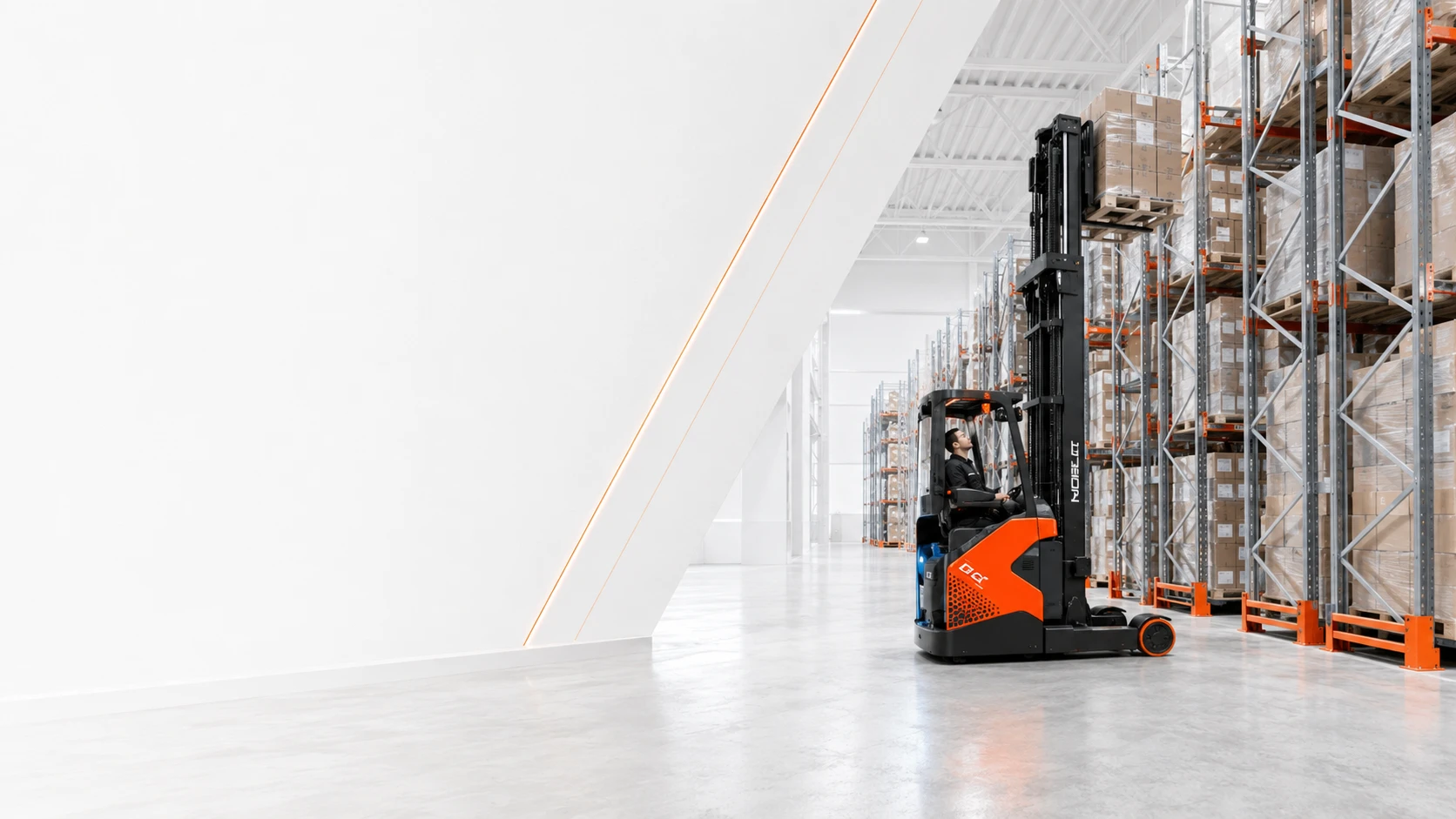
Many Australian warehouses face the same question: do we need a reach truck, a counterbalance forklift, or both?
Both lift pallets, but they are built for different jobs. Choosing the wrong one can mean wasted aisle space, slower put-away, or a truck that struggles at the dock.
This article compares the two in plain terms, using published Noblelift Australia product information as examples.
Quick answer
- Choose a counterbalance forklift for versatile dock, floor, mixed indoor/outdoor and general pallet handling.
- Choose a reach truck when the priority is efficient storage in narrower aisles and higher racking.
- Many sites use both: counterbalance at the dock and yard; reach trucks inside the racking block.
What a counterbalance forklift is best at
A counterbalance forklift balances the load with a rear counterweight. It is designed for flexible handling across open floors and loading areas.
Typical tasks: loading and unloading trucks; moving pallets across the floor; stacking at moderate heights where aisle width allows; mixed indoor/outdoor work (depending on power source and tyres).
Published Noblelift forklift examples
- FEP20-50NP — lithium electric, 2.0–5.0 tonnes, lift heights 3,000–6,500 mm
- FE3D16-20N1 — three-wheel lithium electric, 1.6–2.0 tonnes, lift height up to 6,500 mm, turning radius 1,620 mm
- A Series CPD15-100L — lithium electric, published capacities 1.5–10.0 tonnes
- CPCD20-100L — LPG and diesel (IC from 2.0 t), capacities 2.0–10.0 tonnes
Browse the overview on the forklifts page.
What a reach truck is best at
Reach trucks are designed for warehouse racking. A reach mechanism lets forks extend into the rack while the truck stays in the working aisle, helping sites store more in less floor space.
Typical tasks: put-away and retrieval in selective or high-bay racking; narrower aisle layouts; higher lift applications; indoor distribution and 3PL facilities.
Published Noblelift reach truck examples
- RT16Li — 1.6 tonne lithium reach truck, lift heights up to 9.5 m
- RT15SP / RT15DP / RT15DP-H — pantograph reach trucks with single- or double-deep configurations; published capacity 1,500 / 2,000 kg; lift heights up to 13.8 m
- Additional models on the reach trucks page, including RT16-20G and the XWS-140 walkie reach stacker
Selected RT-series configurations can be discussed for freezer/cold-storage customisation where required.
Side-by-side comparison
| Decision factor | Counterbalance forklift | Reach truck |
|---|---|---|
| Primary strength | Dock, floor and yard versatility | High racking and space-efficient storage |
| Aisle needs | Generally more working width | Built for narrower warehouse aisles |
| Typical lift focus | General material handling heights | Higher warehouse racking heights |
| Outdoor use | Often possible with right power/tyres | Usually indoor warehouse equipment |
| Dense / double-deep storage | Limited | Strong fit with double-deep options |
Five questions that usually decide it
1. Where will the truck spend most of its time?
Dock, staging and travel between buildings → start with counterbalance. Inside a racking block for put-away and retrieval → start with a reach truck.
2. How narrow are your aisles?
Measure working aisle width carefully, including pallet overhang. Reach trucks are aimed at narrower aisle storage. Compact three-wheel counterbalance models help on tighter floors, but they are not a full substitute for a reach truck in high-density racking.
3. How high do you store?
Compare top beam height with published lift bands. For example, RT16Li lists up to 9.5 m; the RT15 pantograph/double-deep range lists up to 13.8 m. Confirm exact mast options for your racking.
4. Do you need double-deep storage?
Double-deep racking points to trucks such as the RT15DP / RT15DP-H. A standard counterbalance forklift is not the right tool for second-pallet reach into double-deep racking.
5. Will one machine do everything?
Small sites sometimes run one versatile counterbalance forklift. As throughput and racking density grow, many warehouses separate roles: counterbalance for inbound/outbound, reach trucks for storage.
Common scenarios
- Retail DC with high selective racking: reach truck for storage; counterbalance for unloading/marshalling if vehicle loading is frequent.
- Light industrial mixed indoor/outdoor site: counterbalance is usually the better all-rounder. Power source depends on how much work is indoors — see the forklifts range.
- Growing 3PL adding denser storage: introduce reach trucks when racking gets higher or narrower; double-deep options can increase pallet positions without expanding the building.
- Cold store / freezer warehouse: reach trucks are common in temperature-controlled layouts. Ask about freezer-ready RT-series configurations and confirm details with an authorised dealer.
Cost thinking without the hype
Look beyond purchase price:
- aisle or racking changes needed for the truck type
- operator training for each machine class
- charging or fuel logistics
- planned service and parts access through the dealer network
Noblelift Australia supports sales, hire/rental where available, servicing and parts through authorised dealers. Start with service and support or find a dealer.
Shortlist in five steps
- Map your top daily pallet flows (dock → staging → rack → dispatch).
- Mark which flows are racking-intensive versus travel/dock-intensive.
- Shortlist counterbalance if dock/floor work dominates.
- Shortlist a reach truck if racking put-away/retrieval dominates.
- If both dominate, plan a two-equipment workflow rather than forcing one machine to do everything.
FAQ
Can a counterbalance forklift replace a reach truck in narrow aisles?
Sometimes for low-level or wider-aisle work, but usually not for high-density, high-level storage. Measure aisle width and lift height before assuming one truck covers both roles.
Are reach trucks only for large distribution centres?
No. Any warehouse using higher racking and wanting better space utilisation can benefit. Confirm aisle width, floor condition and operator training.
What capacity reach truck do I need?
Match capacity to your heaviest regular pallet at the required lift height and load centre. Noblelift’s published RT examples include 1.5–2.0 tonne class machines; confirm residual capacity at height with a dealer.
Who handles sales and servicing?
Sales advice, hire/rental where available, servicing and parts are supported through Noblelift’s authorised dealer network. Use the contact page or call 1300 988 556.
Next step
Compare the reach trucks and forklifts ranges, then contact Noblelift Australia. Share aisle width, top beam height and typical pallet weight so an authorised dealer can recommend a practical configuration.