
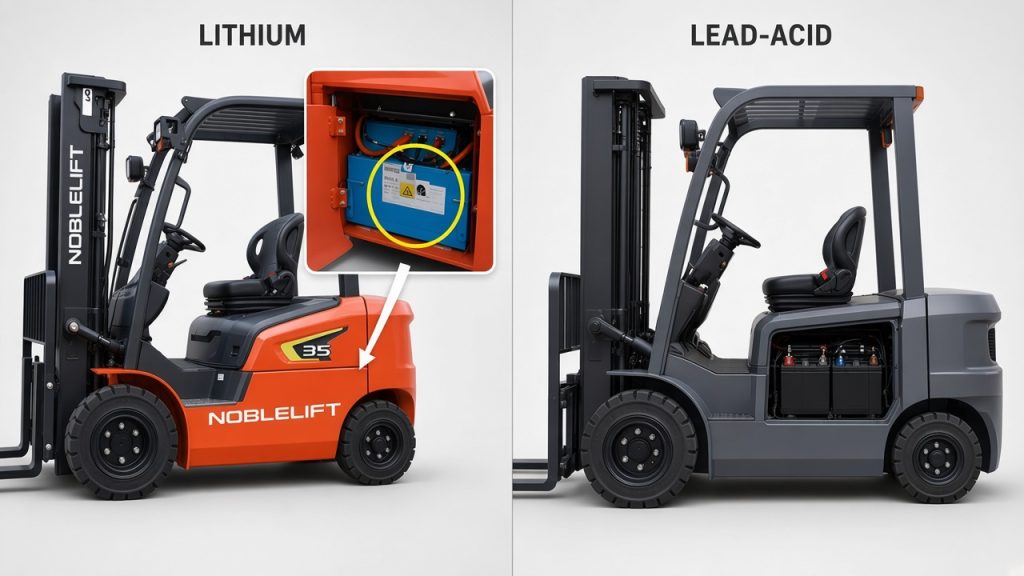
Key takeaways
- Charging efficiency: lithium about 90–98%, lead-acid about 70–85%.
- Battery life: lithium 3,000+ rated cycles (about 12 years at 250 cycles a year); lead-acid 1,000–1,500 (about 5 years).
- In our example, lithium saved about $340 a year on electricity and about $780 a year in battery-care labour per truck.
- Lithium needs no watering and, in many applications, no separate ventilated charging area.
- Lead-acid can still win for light, single-shift use with an existing charging room.
Choosing between lithium and lead-acid often comes down to lithium vs lead acid running costs over the life of the truck, not just the sticker price. Lead-acid has been the default for electric forklifts for decades. In addition, it usually costs less upfront. Lithium-ion costs more on day one. However, it can cut running costs over time. So which option actually works out cheaper for an Australian business?

The honest answer is: it depends on how hard you work the truck. This guide walks through the real cost items. It uses clearly labelled example numbers in AUD. Therefore, you can run the sums for your own site.
What costs separate lithium and lead-acid forklifts?
First, purchase price is only one line in the budget. Over the life of an electric forklift, several costs separate lithium and lead-acid:
- Energy: how much electricity it takes to put a full day’s work back into the battery.
- Battery replacement: how many years the battery lasts before it needs replacing.
- Maintenance labour: watering, cleaning, equalising charges and checks.
- Charging infrastructure: dedicated charging areas, ventilation and, for multi-shift lead-acid work, spare batteries and changeover gear.
- Downtime: time the truck isn’t working because it’s charging, cooling down or having its battery swapped.
How much cheaper is lithium to charge?
Lithium batteries are more efficient to charge. Industry figures put lead-acid charging efficiency at roughly 70–85%. By contrast, lithium-ion sits at about 90–98%. In plain terms, more of the power you pay for ends up in the battery. Less is lost as heat and gassing.
Moreover, Australian business power isn’t cheap. Indicative 2025 figures from energy broker Zembl put average blended small-business rates at around 26c/kWh in Victoria and 30c in Queensland. NSW sits at about 32c and South Australia at 41c (including GST). Your own tariff could be higher or lower.
Example: one forklift, one shift a day
Example only, using assumed figures. Say your forklift draws 15 kWh from its battery each working day. Assume 250 working days a year at 32c/kWh:
- Lead-acid at about 75% charging efficiency: 15 ÷ 0.75 = 20 kWh from the grid per day, or about $1,600 a year.
- Lithium at about 95% efficiency: 15 ÷ 0.95 ≈ 15.8 kWh per day, or about $1,260 a year.
That’s a saving of roughly $340 a year in this example. Still, energy alone rarely makes the case. Instead, the bigger differences show up in battery lifespan. They also show up in the work and space a lead-acid battery needs.
How long does each battery last before replacement?
A typical lead-acid traction battery commonly carries a rating of around 1,000–1,500 full cycles. That depends on depth of discharge and how well you look after it. Meanwhile, lithium iron phosphate (LiFePO4) forklift batteries commonly carry a rating of 3,000 cycles or more.
Example only: at one full cycle per working day and 250 days a year, a 1,200-cycle lead-acid battery lasts about five years. By comparison, a 3,000-cycle lithium battery would last around 12 years under the same use. If you plan to keep the truck for ten years, the lead-acid truck may need a replacement battery partway through. Therefore, it’s worth factoring that into your comparison.
The Noblelift FEP20-50NP lithium counterbalance forklift uses CATL lithium cells. It comes with a 3-year factory machine warranty. Noblelift Australia can extend that to up to 5 years. As the brochure states, battery warranty depends on pack size: 536Ah and 804Ah packs carry 8 years/16,000 hours. Meanwhile, 684Ah and 906Ah packs carry 6 years/12,000 hours. Of course, warranty conditions apply.
Maintenance labour
Lead-acid batteries need regular attention: topping up with distilled water, checking electrolyte, cleaning terminals and running equalising charges. It’s not hard work. Nevertheless, it’s someone’s time every week, plus PPE and spill kits.
Example only: 20 minutes a week of battery care at $45 an hour is about $780 a year per truck. That is before you count missed or rushed maintenance that shortens battery life. Lithium batteries are sealed and don’t need watering. As a result, this line largely drops away.
Do lead-acid forklifts need a ventilated charging room in Australia?
Lead-acid batteries release hydrogen gas while charging. Furthermore, hydrogen is explosive in air at concentrations between about 4% and 75%. Safe Work Australia’s general guide for industrial lift trucks says charging areas should be ventilated so gases disperse. There should be no smoking or open flames. Additionally, eye-wash and washing facilities should be nearby. Likewise, spill kits and fire extinguishers should be on hand, with trained staff doing the charging. In particular, Australian Standards for vented batteries in buildings (AS 3011.1 and AS 2676.1) set out how ventilation is calculated.
For a small warehouse or yard, that can mean setting aside floor space. In addition, it can mean fitting ventilation and keeping acid-handling gear on site. Noblelift’s lithium equipment doesn’t need watering or a separate ventilated charging area in many applications. Consequently, that can free up space and simplify charging. You should still follow the charger and battery instructions. Also do your own site risk assessment.
Downtime and spare batteries
A lead-acid battery typically needs a long full charge (often 6–10 hours) plus a cool-down. If you run more than one shift, that usually means a spare battery and a changeover process. Lithium supports opportunity charging. In other words, that means short top-ups at smoko or lunch, without the same penalty to battery life.
Noblelift quotes typical charging times of about 1.5–2 hours for its lithium electric forklifts. For lithium pallet jacks and stackers, times are about 1–2 hours, depending on equipment and battery capacity. As a result, for many sites one battery can cover a full day or more with sensible top-ups.
Lithium vs lead acid: which is cheaper for you?
Lead-acid can still make sense for light, single-shift use. That is where the truck sits idle a lot and you already have a compliant charging area. Lithium tends to come out ahead when:
- The truck works most of the day, or across more than one shift.
- You don’t have, or don’t want to build, a ventilated charging area.
- Floor space is tight, or staff time for battery care is hard to find.
- You plan to keep the truck long enough to avoid at least one battery replacement.
A simple way to compare lithium vs lead acid is to add up ownership costs over the years. Include purchase price, energy, any battery replacements, maintenance labour and charging infrastructure. Finally, your Noblelift dealer can help you plug in real quotes and your own usage.
Noblelift lithium options to look at
- FEP20-50NP lithium counterbalance forklift: 2.0 to 5.0 tonne capacities, 80V CATL lithium battery, IPX4 truck rating and IP65 motors and battery.
- A Series CPD15-100L lithium forklifts: 1.5 to 10 tonnes, designed for indoor and outdoor work.
- Edge Pro PTE15/20N electric pallet jack and XWS-140 walkie reach stacker for lighter pallet work with lithium power.
Frequently asked questions
Is a lithium forklift always cheaper than lead-acid?
No. For light, occasional use, lead-acid’s lower upfront price can win. Lithium usually pays off with higher daily hours or multi-shift work. Additionally, it helps where a ventilated charging area would be needed.
Do lithium forklifts need a charging room?
In many applications Noblelift lithium equipment doesn’t need a separate ventilated charging area. However, always follow the manufacturer’s charging instructions and your site’s risk assessment.
How much can I save on electricity?
It depends on your usage and tariff. In our example, lithium’s better charging efficiency saved about $340 a year for one truck, one shift. Your dealer can help estimate your figures.
Can I finance a lithium forklift?
Finance and hire options may be available through authorised Noblelift dealers. Ask your local Noblelift dealer about what suits your business.
How long does a lithium forklift battery last compared with lead-acid?
About twice as long or more. Lithium batteries are commonly rated for 3,000+ cycles against 1,000 to 1,500 for lead-acid, so at one cycle a day for 250 days, that’s about 12 years versus about 5.
Is lithium safer than lead-acid in a warehouse?
It removes two of lead-acid’s main hazards: hydrogen gas while charging and acid handling. You still need to follow the charger instructions and your site risk assessment.
Ready to talk to a Noblelift dealer?
Want to see what lithium would cost on your site? Request a quote from Noblelift Australia or find your local Noblelift dealer. Tell us what you lift, how high and how many hours a day, and we’ll help you compare. Visit noblelift.com.au, call 1300 988 556 or email sales@noblelift.com.au.